

Prediction markets have come under criticism for allowing people to bet on disasters.
During the Los Angeles wildfires earlier this year, people wagered on how far individual fires would spread, when they would be contained, and how much damage they would cause. There is an “ick” factor here that one can feel, even if it isn’t immediately obvious where it comes from.
The first concern that is generally raised about prediction markets is that someone who profits from a fire (or other catastrophe) now has a financial incentive to make it worse. Even if almost nobody acted on that incentive, there remains the question of the market’s own moral culpability in creating the opportunity.
In other words, do enabling agents like technology and markets bear responsibility for what they enable? When you make something faster and cheaper, should you be held accountable for what follows?
Technology is frequently described as morally neutral because only people possess moral agency. Guns don’t kill people; people kill people. Cameras don’t invade privacy; people misuse cameras. Prediction markets don’t start fires; arsonists do.
If we only look at direct responsibility, then that argument is correct, but it overlooks the mechanism by which technology changes society: technologies generally reduce friction, or in other words, increase efficiency. They make an activity cheaper, faster, easier, or more liquid. As costs fall, more people perform that activity, more often. Whether that is a good thing in aggregate depends entirely on what it is that has become easier.
Cameras illustrate the point well. Professional video equipment was once expensive, cumbersome, and obvious. If someone was filming, everyone knew it. Consumer camcorders reduced the cost of recording and made documenting events easy. The recording of the Rodney King beating became one of the defining pieces of evidence of the early 1990s because the technology had become accessible enough for an ordinary bystander to capture it.
Smartphones took that further. Recording became almost free, and society gradually abandoned the assumption that public events would go undocumented. (However recording video still requires a visible social signal: phone up, light on. Google Glass violated that social contract not because it had a camera, but because it enabled invisible recording. This turned out to be a huge line in the sand. Who knew.)
Vicarious Culpability
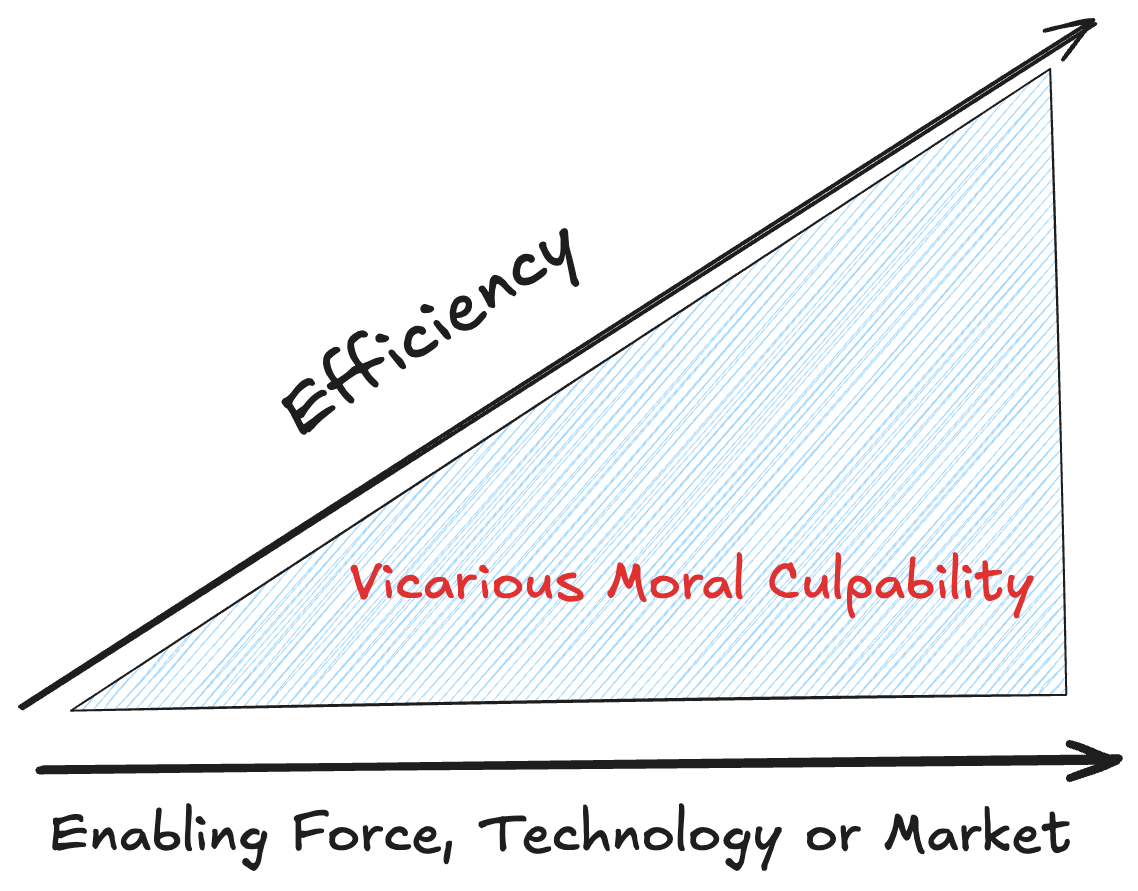
So when cameras are ubiquitous, and shooting video is everywhere, what is the responsibility of the smartphone manufacturers when they’re used to do something bad, such as invade someone’s privacy? They’re not directly culpable, but I’d argue they incur what I call vicarious culpability.
The idea comes from the legal concept of vicarious copyright infringement. A party can be held liable without directly committing infringement if it controls the environment in which infringement occurs and profits from it. The law recognizes that responsibility can attach to creating and benefiting from the conditions under which harmful acts become easier.
When a technology, market, or other means greatly increases the capability of bad outcomes and actors by removing friction, they should bear vicarious culpability for what happens. If someone commits arson so they can make a bet on things burning in a prediction market, that market bears vicarious culpability for that act.
It’s not just about bad stuff though. The same principle deserves consideration whenever efficiency increases, causing good things to happen. Lowering the cost of cancer treatment, transportation, or communication is socially valuable because society wants more of those activities. The enabling efficiency booster should be praised for this.
This is bigger than markets (prediction or otherwise) or technology. It’s about anything that changes the economics of human behavior by making some actions easier than others. Those changes alter incentives, and altered incentives change the equilibrium of the system. The designer may not commit the eventual act, but neither have they remained outside it. They have intentionally changed the conditions under which people make decisions.
Efficiency is therefore not a nonmoral act. Whenever we reduce friction around an activity, we should ask whether that is an activity society actually wants to encourage, because making something easier is one of the most powerful ways to increase how often it occurs.
I wish more folks would think about technology in this way. Thanks for this thoughtful analysis.